
First-time horror short story guide
If you’re learning how to write a horror short story for the first time, start by thinking small: one character, one pressure point, one escalating disturbance, and one consequence. A horror short story is a brief work of fiction built to create dread, unease, shock, or disturbing recognition through a tightly controlled situation. The goal is not to explain an entire world. It is to make one frightening change feel unavoidable.
You’ll learn how to:
- Turn a general fear into a story-sized premise.
- Build tension without explaining the threat too early.
- Draft with a simple five-beat horror structure.
- Revise with a practical readiness rubric before sharing or submitting.
A horror short story is a compact narrative in which an ordinary or understandable situation becomes threatening, uncanny, or morally disturbing. A useful beginner target is a complete change in the character’s reality, not a pile of scary imagery. Give the reader something to care about, narrow the character’s choices, and end with a consequence that changes how the earlier details are understood.
What is a horror short story?
A horror short story compresses fear into a limited narrative space, usually around one dominant disturbance and its consequences. For a first draft, choose one fear worth following and make every major beat serve it.
Horror can be supernatural, psychological, bodily, social, cosmic, realistic, or some mixture of those modes. The form is defined less by a specific monster than by what the story makes the reader feel: dread, vulnerability, revulsion, helplessness, uncanny recognition, or the sense that ordinary rules no longer protect the character.
The short form rewards focus. The Horror Writers Association’s discussion of why short-form horror works emphasizes that short stories use a tighter toolkit, give writers room to experiment, and leave less space for filler.
Build the story around four parts
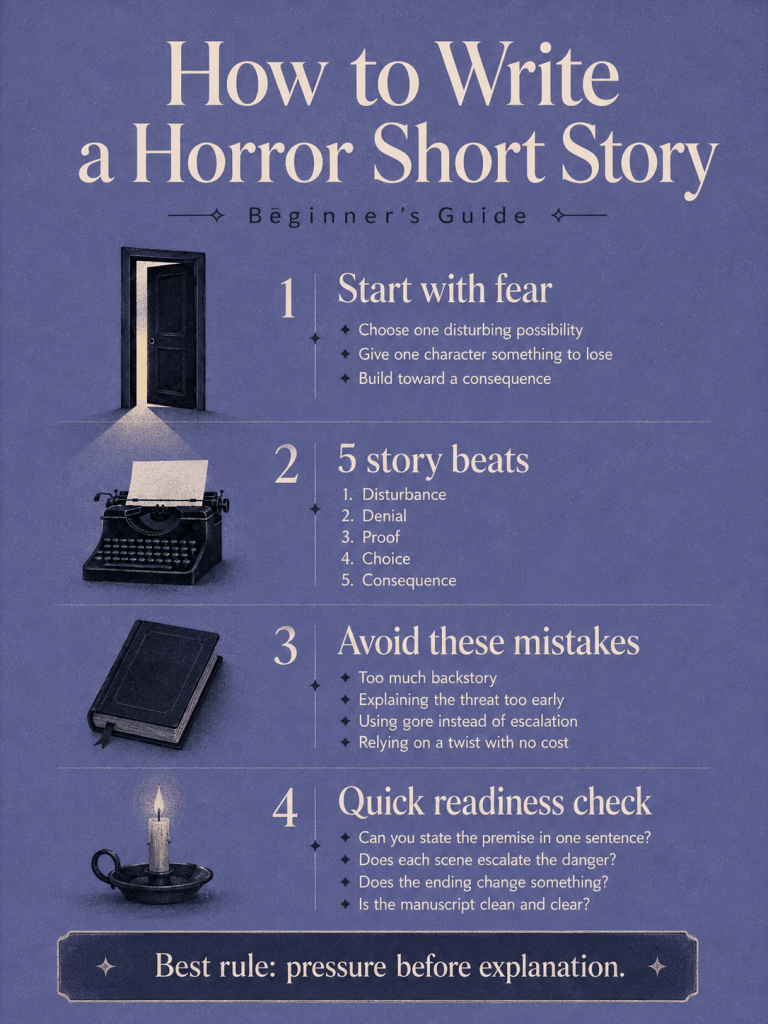
- Fear: What possibility disturbs you enough to keep testing it?
- Character: Who has the most to lose if that fear becomes real?
- Pressure: What keeps removing safe explanations or escape routes?
- Cost: What changes permanently because the character faced the threat?
For an even smaller practice format, WriteLight’s flash horror challenge shows how a single unsettling moment or reveal can carry a complete piece.
Why start with short-form horror instead of a novel?
Short-form horror gives a new writer fewer moving parts to manage while still demanding real control of character, tone, pacing, and ending. That makes it a useful craft laboratory for learning what scares readers.
A short story lets you test one voice, one rule-breaking idea, or one form of dread without building a book-length plot around it. That constraint is useful because horror loses force when the writer keeps adding explanation after the reader already understands the danger.
In a 2024 Horror Writers Association interview, editor Ellen Datlow described strong short fiction as a combination of voice, a fresh approach, engaging characters, and an idea or plot that holds attention. For horror specifically, she also looks for a growing sense that something is seriously wrong. Read the HWA interview with Ellen Datlow.
Use the short form to practice controlled unease
Instead of trying to scare the reader in every paragraph, let one detail become harder to dismiss. A sound occurs twice. A trusted person remembers an event differently. A door opens onto the wrong room. Each new beat should reduce the number of innocent explanations.
If your fear is tied to grief, identity, family, isolation, or another human pressure, WriteLight’s guide to horror with deeper thematic focus offers useful ways to connect the threat to the character’s inner problem.
A horror story does not need the biggest monster. It needs the smallest detail the reader cannot explain away.
What mistakes do first-time horror writers make?
First-time horror drafts can lose force when they explain too much, start too early, repeat familiar imagery, or save the entire story for one twist. The fix is pressure before extra information.
Mistake 1: opening before anything changes
Backstory feels important because you created it. The reader does not need all of it before the first disturbance. Start near the moment normal life develops a crack, then reveal only the past that changes how the present danger is understood.
WriteLight’s guide to hooking readers from the first line makes the same practical point: opening scenes should move the story instead of asking readers to wait through a history lesson.
Mistake 2: explaining the threat as soon as it appears
Explanation can kill uncertainty. Give readers enough information to track cause and effect, but do not answer every question the moment it forms. A rule can become clear while the origin remains unknown.
Mistake 3: using a familiar object without a fresh consequence
Mirrors, dolls, basements, forests, abandoned hospitals, strange children, and old photographs can all work. The problem is not the object. The problem is predictable behavior. Ask what your version does that changes the character’s choices in a way the reader did not expect.
Mistake 4: confusing gore with escalation
More blood does not automatically mean more fear. Escalation means the situation becomes more dangerous, more personal, less reversible, or less understandable. A quiet phone call can escalate a story more than another corpse if the call proves the threat knows something private.
Mistake 5: writing toward a twist instead of a consequence
A twist is information. An ending is a change. After the reveal, ask what the character must now do, lose, accept, become, or understand. The last image should feel connected to the story’s earlier pressure, not attached afterward to surprise the reader.
How do you write a horror short story from beginning to end?
A horror short-story draft becomes easier when you separate invention from repair. Build a simple sequence first, draft through it without constant polishing, then make revise in focused passes for fear, clarity, and prose.
Step 1: write the fear sentence
Complete this sentence: “This story scares me because it suggests that ______.” The answer should name the disturbing possibility underneath the plot, not the monster’s biography.
Step 2: give the protagonist an ordinary want
The character should want something before the horror takes over: sleep, privacy, approval, money, forgiveness, a ride home, five quiet minutes. Horror becomes sharper when the threat interrupts a recognizable need.
Step 3: define one rule of the threat
You do not need a full lore document. Choose one rule the reader can observe. The voice only speaks through unplugged radios. The figure moves when someone lies. The house changes one room after every argument. A rule gives the reader something to anticipate.
Step 4: outline five beats
- Disturbance: Something is off.
- Denial: The character finds a safe explanation.
- Proof: The safe explanation fails.
- Choice: The character acts under pressure.
- Consequence: The action solves, worsens, or permanently reframes the problem.
Step 5: draft toward the consequence
Do not stop every few sentences to perfect the prose. Finish the chain of cause and effect first. During revision, cut setup that the reader can infer, sharpen vague nouns and verbs, and check whether each scene changes the level or meaning of the threat.
Step 6: prepare the clean version
If you plan to submit the story, market rules outrank generic formatting advice. In an HWA craft article, Lisa Morton advises writers to send clean manuscripts and follow each publication’s stated guidelines. Review HWA guidance on submitting short fiction before sending work out.
What does a beginner horror story template look like?
A beginner horror story template should leave room for invention while preventing the draft from spreading in too many directions. Use one disturbance, choice, and cost as the spine of the piece.
Reusable horror short story template
- Normal: Show the character doing something ordinary that reveals what they want.
- Disturbance: Introduce one detail that should not be there.
- Dismissal: Let the character choose the safest explanation.
- Second signal: Repeat or alter the disturbance so coincidence becomes harder to believe.
- Personal turn: Connect the threat to a secret, relationship, memory, body, home, or identity.
- Forced choice: Make the character act before they feel ready.
- Cost: Let the choice remove something that cannot be restored easily.
- Final image: End on a concrete detail that shows what has changed.
Example application: “The apartment with no basement”
This example is invented for this guide. A tenant wants one quiet night before an early job interview. At 2:14 a.m., a basement light appears on the building’s smart-home app even though the building has no basement. She dismisses it as a software error.
The next night, the app adds a basement door sensor and records it opening. Then the sensor history shows her apartment key being used downstairs. When she deletes the device, her front door disappears from the app instead.
Her forced choice is simple: leave the apartment or stay for the interview she cannot afford to miss. She leaves. Outside, the building directory now lists her unit as “B1,” and the front entrance will not accept her key.
The example works as a drafting model because each beat changes one fact, narrows one explanation, and makes the disturbance more personal. It does not need a history of the building or a full explanation of what lives below it.
How do you know your horror short story is ready?
A horror short story is ready when the premise is clear, the character’s choices matter, the unease escalates, and the ending changes something. Use a revision decision rubric instead of revising forever by instinct.
| Revision question | Ready signal | Revise if… |
|---|---|---|
| Can you state the premise in one sentence? | The sentence names the character, disturbance, and pressure. | You need several paragraphs of lore to explain what the story is about. |
| Does the protagonist want something before the threat takes over? | The reader can identify an ordinary goal or need. | The character exists only to walk toward scary events. |
| Does each major beat change the situation? | Every scene adds proof, pressure, risk, or a harder choice. | Several scenes create the same kind of scare without changing the problem. |
| Have you left useful uncertainty? | The reader understands what is happening well enough to follow the danger but still has meaningful questions. | The story explains every origin, rule, motive, and symbol before the ending. |
| Does the ending create a consequence? | The final beat changes the character’s situation, understanding, identity, safety, or relationship. | The story stops immediately after revealing hidden information. |
| Is the manuscript clean enough to share or submit? | Typos, grammar problems, and formatting distractions have been checked, and target-market rules have been reviewed. | You are relying on an editor or reader to repair basic presentation issues. |
Source note: This rubric is a WriteLight synthesis of the Horror Writers Association guidance cited in this article on short-form focus, voice and freshness, unease, manuscript cleanliness, and submission guidelines.
Run one final fear test
Ask what the reader should feel in the final paragraph and which earlier detail earned that feeling. If the ending depends on information that appears only at the end, plant an earlier signal. If the ending feels obvious, change the consequence before changing the entire premise.
Beginner horror short story FAQ
These beginner horror questions cover length, monsters, gore, endings, and submission readiness. The shared principle is clarity before added complexity: finish a coherent story before chasing extra effects.
How long should a horror short story be?
There is no single universal length for every short-fiction market. Write the story as tightly as you can, then follow the word-count rules of any publication or anthology you plan to target. If you are practicing flash fiction, expect a much smaller range than standard short fiction.
Do I need a monster or supernatural element?
No. Horror can come from a person, an institution, a memory, a body, a social situation, an unexplained event, or a supernatural threat. What matters is that the story creates sustained unease and meaningful danger or disturbance.
Do horror stories need gore?
No. Gore is one possible tool, not a requirement. A restrained story can be deeply disturbing when the reader understands the stakes and senses that the character’s safe explanations are disappearing.
Should I explain what the monster or threat really is?
Explain enough for the reader to understand the story’s cause and effect. You can leave origin, motive, or mechanism uncertain when that uncertainty strengthens the ending rather than covering a plot gap.
Can my first horror story be good enough to submit?
Yes. “First” describes your experience level, not the quality ceiling of the finished piece. Revise it, proofread it, get useful feedback if available, and follow the target market’s current submission rules exactly.
Key takeaways
First-time horror writing becomes easier to revise when you reduce the problem to a few repeatable choices. Keep fear, pressure, and consequence visible from premise through revision.
- Start with one disturbing possibility, not a whole mythology.
- Give the protagonist an ordinary want so the threat has something concrete to disrupt.
- Escalate by removing safe explanations and narrowing choices, not by stacking random scares.
- Use a short beat outline to reach the consequence before polishing the prose.
- Revise for freshness, clarity, unease, and a final change that the earlier story earns.
- Follow the exact guidelines of any market you submit to.
Finished your first horror story?
If you want help deciding what to do with the draft next, including submission support or a broader publishing path, bring the story and your questions to WriteLight Group.
Talk with WriteLight GroupSources
These sources support the guide’s claims about short-form focus, story quality, unease, and submission readiness. They were reviewed on September 3, 2026; all source links were verified before drafting.
- Horror Writers Association, “A Flash of Fear: Why Write Short-form Horror”.
- Horror Writers Association, “Nuts & Bolts: Interview With Ellen Datlow, Editor and Shaper of Multiple Genres”.
- Horror Writers Association, “SUBMIT!: Some Long Truths About Short Fiction” by Lisa Morton.
0 Comments